 info@oasisbookshop.com
 +254759175870
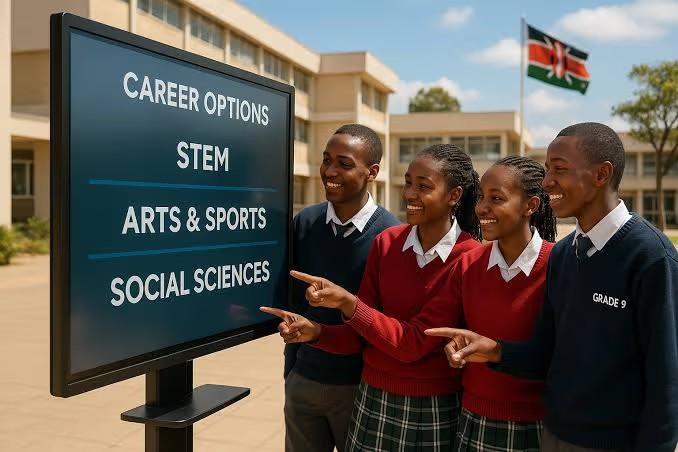
If you ask any Kenyan parent or teacher today, they will tell you—education is no longer what it used to be. With the full rollout of the Competency-Based Curriculum (CBC), the journey a learner takes in school has become more personal, more flexible, and, in many ways, more meaningful.
Grade 10 marks a major turning point.
This is where learners transition into Senior School and, for the first time, begin to make structured choices about what they want to pursue. It is both exciting and, for many families, a bit overwhelming.
A New Chapter: What Grade 10 Really Means
Gone are the days when every student followed the same rigid subject combination. In today’s system, Grade 10 is about direction.
Learners are expected to reflect on their strengths, interests, and long-term goals. Whether a student is passionate about science, business, music, or sports, there is now space to grow in that direction.
But how exactly are these choices organised?
The Three Pathways in Senior School
At Grade 10, learners select from three main pathways. Think of these as broad career directions rather than fixed boxes.
1. Arts and Sports Science Pathway
This pathway finally gives recognition to talents that were often sidelined in the past.
If a learner excels in creative expression or athletics, this is where they belong.
Subjects and areas here may include:
- Music, dance, and theatre
- Fine arts and design
- Physical education and sports science
For a long time, many talented young Kenyans were told to “focus on academics.” Today, that narrative is changing—and rightly so.
2. Social Sciences Pathway
This is a familiar and popular route for many students.
It caters to learners interested in society, business, communication, and governance.
Subjects may include:
- History and Government
- Geography
- Business Studies
- Languages such as English and Kiswahili
- Religious Education
This pathway opens doors to careers in law, teaching, entrepreneurship, journalism, and public service.
3. STEM Pathway
STEM remains a cornerstone of Kenya’s development ambitions.
This pathway is ideal for learners who enjoy problem-solving, experimentation, and innovation.
It includes areas such as:
- Mathematics and advanced sciences
- Biology, Chemistry, and Physics
- Computer Science and technology
- Engineering and technical studies
As Kenya continues to grow in sectors like infrastructure, ICT, and healthcare, this pathway plays a critical role in shaping the workforce of tomorrow.
Core Subjects: What Everyone Learns
Even with specialization, there are subjects every learner must take. These ensure a balanced education.
They include:
- English
- Kiswahili or Kenyan Sign Language
- Community Service Learning
- Physical Education
These subjects help learners develop communication skills, social awareness, and overall well-being—skills that go beyond the classroom.
The Power—and Challenge—of Choice
Let’s be honest: giving a 15- or 16-year-old the responsibility to choose a career path is not a small matter.
While this system empowers learners, it also raises important questions:
- Are students receiving enough career guidance?
- Do all schools offer equal subject choices?
- Are parents adequately informed to support their children?
In many parts of Kenya, access and resources remain uneven. Some schools may not yet have the facilities to offer all pathways fully.
This is where we, as an education community—teachers, parents, policymakers—must step in.
Why This Shift Matters
As someone deeply invested in Kenya’s education sector, I see this reform as a necessary step forward.
For too long, we measured intelligence through a narrow academic lens. But our country is rich in diverse talents—artists, innovators, athletes, entrepreneurs—who all deserve a chance to thrive.
The Grade 10 pathway system acknowledges one simple truth:
not every learner is the same, and that is our greatest strength.
Final Thoughts
The success of this new system will depend on how well we support our learners during this transition.
We must:
- Strengthen career guidance in schools
- Invest in teacher training and infrastructure
- Ensure equity across counties
If we get this right, we will not just be educating students—we will be nurturing a generation that is confident, skilled, and ready to shape Kenya’s future.
What are your thoughts on the Grade 10 pathways? Do you think students are ready to make these choices? Let’s continue the conversation.